

Every year, Codenrock hosts numerous hackathons, ML competitions, CTF events, and competitive programming tournaments. Tens of thousands of participants solve challenges, upload solutions, receive scores, and achieve victories. Until recently, these successes remained hidden — but it’s time to change that.
In our latest update, we have introduced:
- Public user profiles featuring skills, achievements, medals, certificates, and a participation heatmap.
- The Global User Ranking on Codenrock, aggregating points and medals earned by users across all competitions hosted on the platform. This ranking is a transparent framework for comparing results, enabling every Codenrock user to track their own progress and encouraging regular participation in new contests.

To create this rating we partnered with SOUP SUPPORT — a gamedev studio that specializes in building virtual economies and high-fidelity simulations. Their team helped us design and back-test the scoring system to ensure it’s dynamic, stable, and just.
In this article, we will describe the algorithms behind the ranking system, explain how points are earned, and highlight the benefits for participants and IT competition organizers.
How the Global Ranking Works
The «Ranking» section on Codenrock is accessible to everyone and comprises three categories:
- Competitive programming and algorithms
- ML and artificial intelligence
- Hackathons — contests for product development and business solutions

Points
Points are awarded for every solution whether evaluated automatically or by jury. The algorithm takes team size and event-specific details into account.
First, the system analyzes participants’ raw competition results. Calculation methods vary depending on the task:
- Automatic evaluation in ML competitions or competitive programming: The algorithm uses the participant’s best attempt multiplied by the task complexity coefficient.
- Jury evaluation: Points are calculated based on the average total score provided by all judges.
Adjustment for Team Size. A 100-point solution built by a single developer isn’t equivalent to a similarly rated result produced by a team of six. To fairly distribute points, the algorithm accounts for the number of team members.
$$ \text{score}_{\text{team}} = \frac{\sum (\text{points} \times m_{\text{difficulty}})}{\sqrt{N_{\text{members}}}} $$This formula ensures fair comparisons across teams of different sizes, rewarding the best solutions while minimizing the advantage of larger teams.
Result Normalization. Competitions might use custom scoring scales chosen by organizers, different from the traditional 0 to 100-point systems. To properly compare event results, all scores are normalized to a 0-to-1 range using the following formula:
$$ s_{\text{norm}} = \frac{s_{\text{team}} — s_{\text{min}}}{s_{\text{max}} — s_{\text{min}}} $$Final Calculation. Normalized scores are multiplied by 100 and the average complexity coefficient of the entire competition, then added to the participant’s rating. However, points earned from competitions gradually diminish, decreasing weekly according to an exponential decay curve:
$$ \text{raw_points} = s_{\text{norm}} \times 100 \times \text{difficulty}_{\text{contest}} $$Thus, older achievements gradually fade away, creating opportunities for newcomers to compete with veterans on a level playing field. But don’t worry — coefficients are calibrated to ensure only about half the points from a specific competition are lost annually.
Medals
Medals. A medal is a permanent award recognizing participants with the highest-rated solutions. Reflecting traditional sporting trophies, medals come in three types:
- Gold medals are awarded to participants in the top 5%.
- Silver medals go to the top 10%.
- Bronze medals recognize those in the top 20%.
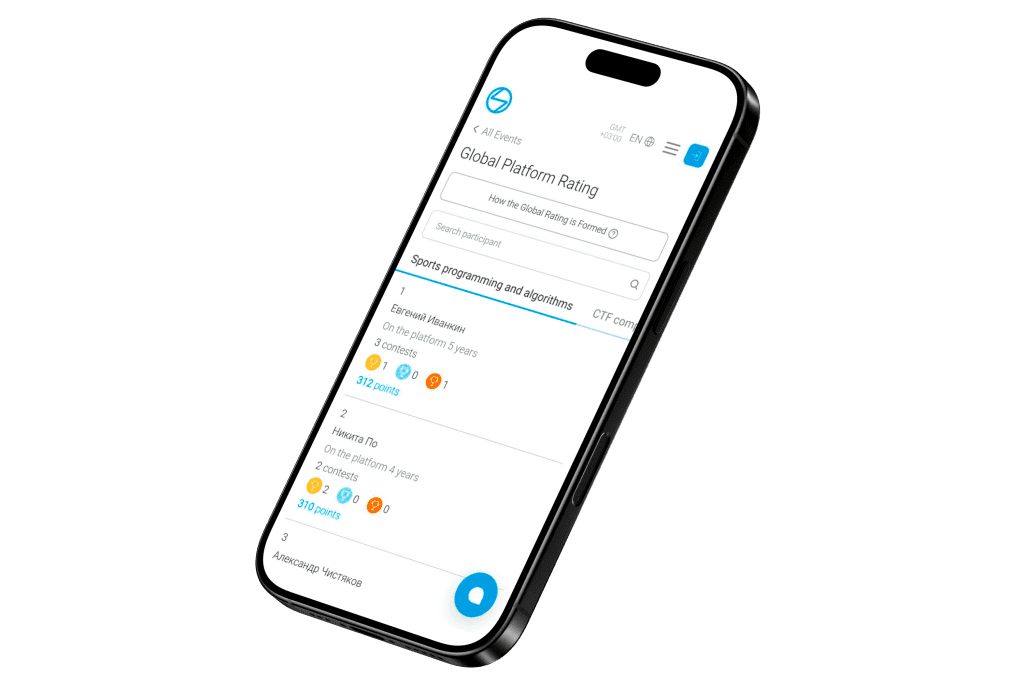
Every fifth participant can expect to add a medal to their collection, providing strong motivation even for challenging contests. Trophies aren’t tied directly to prize placements in hackathons. For instance, a contestant finishing third in one track’s final standings may still earn a gold or silver medal if they rank in the top 10% overall.
Medals enhance profiles and contribute additional points to the global ranking. Higher-level medals add more points and lose their impact only after a year, making them a valuable long-term investment in ranking.
To maintain consistency with medal awarding rules, all competitions on Codenrock now generate a public ranking, whether results are determined automatically or judged. Everyone can assess their standing among peers and understand how their achievements impact the global ranking.
Why the Ranking Matters
Before the introduction of the ranking system, tournaments on Codenrock were isolated: each event had its own leaderboard, and successes in one didn’t influence others. Even consecutive hackathon victories went unnoticed:
- Organizers might overlook experienced, talented, and motivated specialists.
- Team members undervalued their teammates’ expertise.
- Participants lacked the opportunity to showcase their progress on social networks or resumes.
The global ranking resolves these issues and addresses several key goals:
- Reflecting Activity: Each competition influences a user’s overall ranking position. Even without outright victories, evaluated solutions increase scores and rankings.
- Transparency of Skills: Participants and stakeholders can easily assess individual skill levels, engagement, and areas of expertise, both through immediate scores and historical achievements displayed via medals.
- Increased Motivation: Growing the score and accumulating medals gently encourages regular participation in ranked competitions.
Every participant has a chance to reach the top. The algorithm is designed so newcomers can rapidly ascend and veterans can maintain or enhance their positions. There’s no need to register for competitions solely for points if they’re not of genuine interest.
Join Codenrock — register, earn medals, and climb the rankings. Prepare for upcoming IT competitions in the Sandbox, featuring evergreen ML and algorithm tasks. It’s an excellent opportunity to develop skills, explore the platform’s capabilities, and earn points in the Codenrock global ranking.
Частые вопросы
Что такое глобальный рейтинг Codenrock?
Публичный рейтинг, агрегирующий очки и медали пользователей по всем соревнованиям платформы в трёх категориях: спортивное программирование, ML/ИИ и хакатоны. Дополнен публичными профилями с навыками, достижениями, сертификатами и heatmap участия. Скоринг разработан вместе со студией SOUP SUPPORT.
Как начисляются очки в рейтинге Codenrock?
Очки даются за каждое оценённое решение: при автопроверке берётся лучшая попытка с коэффициентом сложности, при жюри — средний балл всех судей. Командный результат делится на корень из числа участников, результаты нормализуются к шкале 0–1 и умножаются на 100 и коэффициент сложности соревнования.
Сгорают ли очки в рейтинге Codenrock со временем?
Да, очки убывают еженедельно по экспоненциальной кривой — примерно половина очков конкретного соревнования теряется за год. Это даёт новичкам шанс конкурировать с ветеранами. Медали действуют дольше: их вклад в рейтинг ослабевает только через год.
Как получить медаль на Codenrock?
Медали — постоянные награды за лучшие решения: золото — топ-5% участников, серебро — топ-10%, бронза — топ-20%. Медаль может получить примерно каждый пятый участник, и она не привязана к призовым местам: третье место в треке может дать золото, если результат в общем топ-10%.
Зачем рейтинг нужен организаторам IT-соревнований?
Раньше турниры были изолированы, и организаторы могли не заметить опытных специалистов. Рейтинг делает навыки прозрачными: видны уровень, вовлечённость и области экспертизы участников — как по текущим очкам, так и по истории медалей. Это помогает находить таланты и мотивирует участвовать регулярно.